
Türkiye exports cherry to China currently preparing to resume
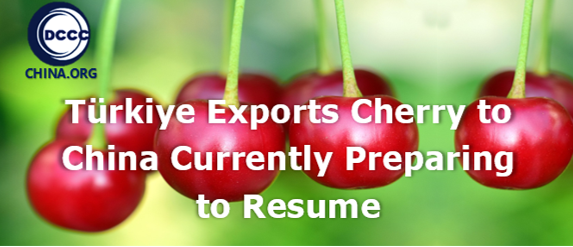 Türkiye is currently preparing to resume its fresh cherry exports to China after trade was suspended during the COVID-19 pandemic.
In late June 2026, a technical delegation from the General Administration of Customs of China (GACC) visited Turkish orchards and packaging facilities in regions like İzmir, Manisa, and Isparta to finalize phytosanitary compliance.
As the world's largest producer of cherries, producing around 700,000 tons annually, Türkiye is heavily targeting China—the world's largest cherry importer.
Look at this recent article from FRESHPLAZA
A technical delegation from China's Customs visited Türkiye last week attending a meeting at the General Directorate of Food and Control on June 23 where officials briefed them on Türkiye's export control procedures, plant health systems, quarantine practices, and food safety standards.
Türkiye’s cherry output of around 700,000 tons, of which 60,000 to 70,000 tons are exported each year to more than 60 countries, including Germany and Russia as the primary markets. China imports between 300,000 and 500,000 tons of cherries annually, according to the source, making it the world's largest importer of the fruit......See more from FRESHPLAZA here
Türkiye exports cherry to China boost
Türkiye exports cherry to China currently preparing to resume, particularly with logistics boost. The removal of strict 16-day cold treatment requirements allows Turkish cherries to reach Chinese consumer markets via air cargo in as little as 12 hours from picking.
Challenges for Türkiye cherry to enter Chinese market
Unlike Chile, which dominates the Chinese winter market by utilizing its Southern Hemisphere counter-season, Türkiye's harvest coincides directly with China's domestic cherry season (May to July/August) which seasonal alignment is quite challenging.
Türkiye face stiff competition in China during the summer months, as local Chinese production (primarily from Shandong and Liaodong) has expanded heavily to hit nearly 900,000 tons per year, competition with China domestic cherry suppliers may face complex situations.
Historically, Turkish cherries faced price drops in China due to post-harvest cold chain limitations compared to U.S. or Canadian imports. To fix this, Turkish exporters are increasingly upgrading to advanced AI-driven packing and strict food safety protocols to appeal to China's premium fruit market, however, over quality & pricing pressure are still there in Chinese market.
It is important to note that Turkish cherries export to China to know the related rules and regulation in China. much useful to understand the packaging criteria, particularly for exporters.
Here are the specific phytosanitary protocol rules required by China Turkish cherry imports
The General Administration of Customs of China (GACC) enforces strict phytosanitary rules for Turkish cherry imports. These protocols mandate meticulous pest monitoring, orchard registration, physical barrier isolation, and clear tracking codes to ensure zero contamination.
1. Quarantine Pests of Concern
Turkish orchards must actively monitor and eliminate specific pests targeted by Chinese customs. The primary threat is the Mediterranean Fruit Fly (Ceratitis capitata), along with the European cherry fruit fly, various scale insects, and mites.
Orchards must deploy fruit fly traps at a density of at least 1 trap per square kilometer. trapping & monitoring are important.
Attractants must be replaced monthly, with inspection frequencies jumping to 4 times a month during the summer harvest. lure maintenance is strict required
2. Orchard and Packinghouse Registration
Only facilities explicitly pre-approved by the Turkish Ministry of Agriculture and Forestry and officially registered by China's GACC can participate in the trade.
Dedicated packing lines must be used solely for China-destined cherries to prevent cross-contamination from other fruits, it is exclusivity.
Registered cherry orchards are forbidden from interplanting or growing any other plant species between the cherry trees, no intercropping is required.
3. Physical Insect-Proofing Rules
Packing facilities must act as biosecure bubbles to block pests from entering after the cherries are cleaned and sorted.
All facility windows, ventilation holes, and box air vents must be completely sealed with fine mesh screens measuring 1.6 mm or smaller, it is mesh screen restrictions
Doors must utilize downward-blowing air curtains, heavy rubber strip curtains, or automated double-door vestibules. that is for the requirement for facility entrances
4. Zero-Tolerance Sorting & Cleanliness
Before moving to the final packaging stage, fruit batches undergo rigorous washing and quality checks.
Consignments must possess absolute zero tolerances for soil, roots, leaves, twigs, rotten fruit, or weed seeds, they are strict prohibited materials:
Packing houses must undergo comprehensive chemical sterilization and pest control treatments before the seasonal harvest begins, it is important cleanliness pre-packing purges.
5. Labeling and Shipping Safeguards
Once the fruit passes inspection, the physical packaging must bear precise markers for quick customs tracking.
Every individual box and large transport pallet must explicitly print in English or Chinese: "Exported to the People's Republic of China" (输往中华人民共和国). libeling in bilingual marking.
Labels must clearly state the product name, region of origin, orchard registration number, and the packinghouse ID, to enable traceability codes
Any wooden pallets or crates must comply strictly with international ISPM 15 standards, meaning they must undergo certified heat treatment or fumigation, special for wood packaging.
6. the list of Chinese importers for cherry fruits in China